
The Handoff Isn't the Finish Line
The design is done. Or at least Figma says it is.
There’s a very satisfying moment in every design project when everything finally looks complete.
The screens are there. Components are organized. The prototype works. The spacing has been checked more times than anyone would like to admit. Maybe the file name has even graduated from Final to Final Final, which we all know is an important milestone in the design process.
Then comes the handoff.
We send the Figma link to the developers, explain the important parts, answer a few questions, and technically, our job is done.
Except it isn’t.
A few weeks later, someone shares the staging link. You open it with excitement, scroll for approximately five seconds, and immediately notice something.
The spacing feels different. A component behaves differently from the prototype. Something that was supposed to be one line is now three. The empty state you designed isn’t there. On mobile, a button has decided to pursue a completely independent life.
And eventually someone asks the classic question:
“But why doesn't it look like the Figma?”
The funny thing is, this usually isn’t because the developer ignored the design or because the designer did a bad job. More often, it happens because we treat handoff as a finish line, when in reality it’s the moment the design finally has to survive outside Figma.
Figma is a very controlled environment. Products are not.
Inside Figma, everything behaves beautifully.
The names fit. The data is clean. The image has the perfect ratio. Every card contains exactly the amount of content we expected. Nobody has a 47-character surname. The API never fails. Internet connections apparently never disappear.
Real products are less cooperative.
Once development starts, all the things we didn’t think about begin showing up.
Maybe the backend returns content longer than expected. Maybe an interaction that looked simple in the prototype requires much more technical effort. Maybe an existing component behaves differently from the one we designed. Maybe a business rule appears halfway through development because someone suddenly remembers that, yes, apparently this flow also needs to work for another type of user.
This is where design stops being a collection of screens and starts becoming a product.
And that transition needs collaboration.
A Figma file can describe the intention. The actual product is where that intention gets tested.
That’s why I’ve become less interested in the idea of a perfect handoff.
I’d rather have a good conversation.
A designer can annotate every pixel, document every state, create a beautiful design system, and write enough documentation to qualify as a small novel. Those things are useful. But documentation can’t predict every decision that development will need to make.
Sometimes a developer just needs to ask:
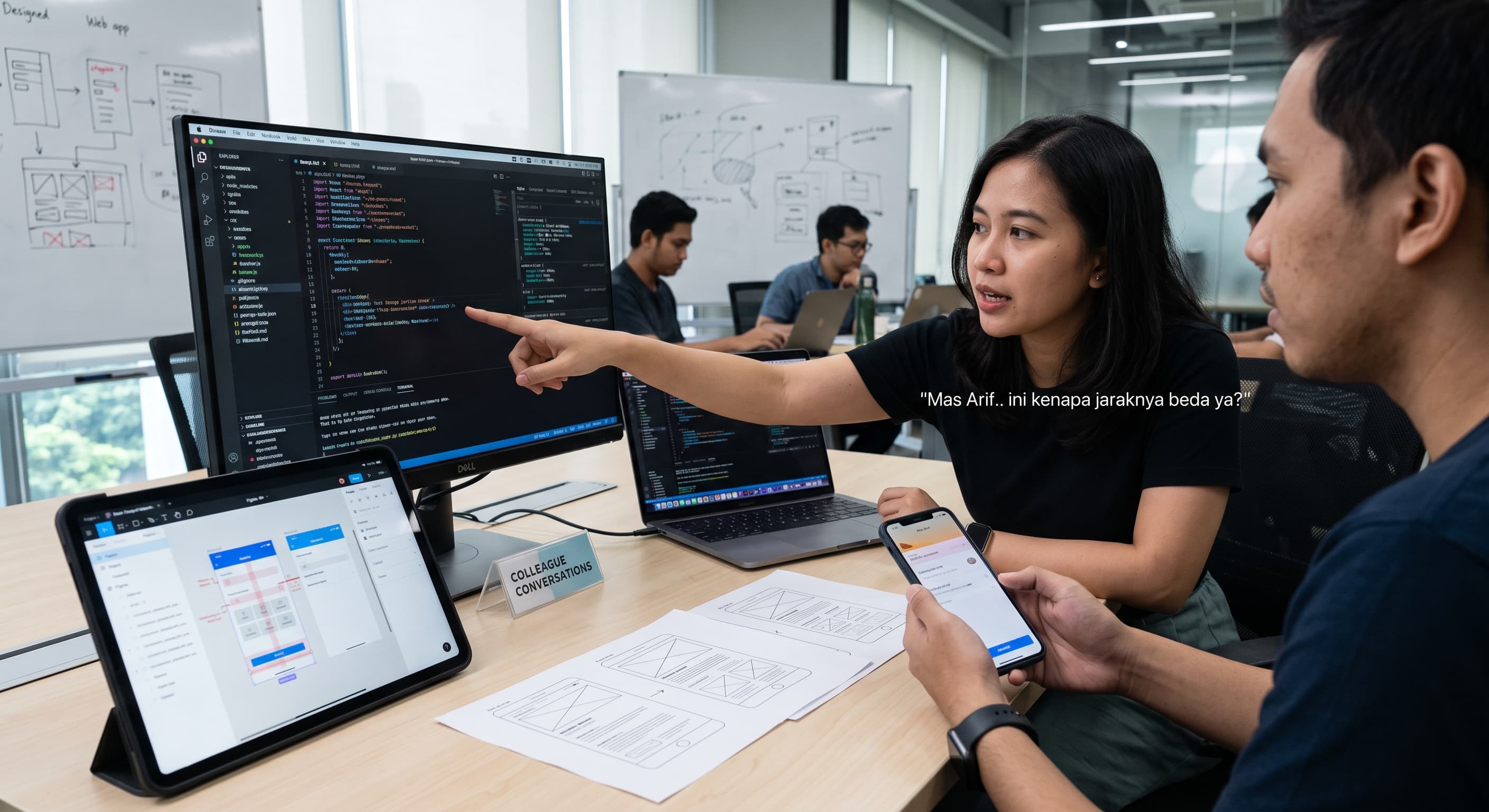
“Mas Mike.. kalau kondisinya begini, maunya gimana?”
And honestly, a five-minute conversation can be more useful than another fifty annotation boxes in Figma.